

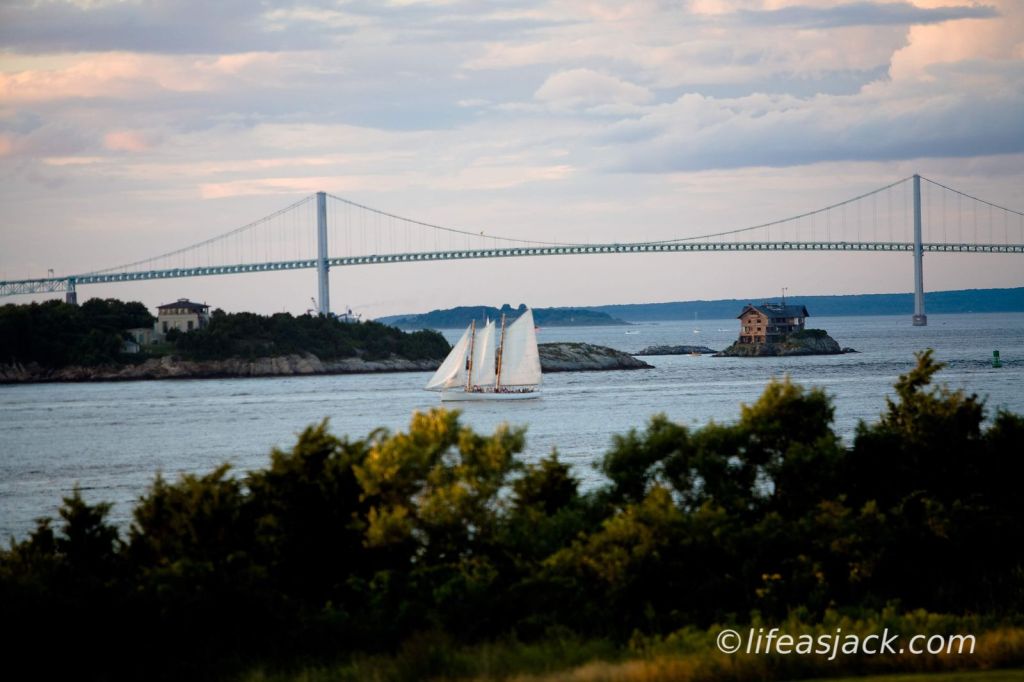
When I worked in Newport, down near the mansions, I often found myself taking a break just before sunset, standing on the cliffs near Ram’s Head in Newport, Rhode Island. Looking towards the Newport Bridge, I could watch the schooners ply the waters off Newport Harbor. Occasionally an “out of towner” would spy the house. It squatted on a rocky perch at the entrance to the East Passage of Narragansett Bay.
“Why is that house way out there on that rock?”
Your old buddy Jack, who was a different person then, would swish the water and melting ice cubes in his glass and begin.
The house is known as “Clingstone” and it has an interesting story.
One upon a time in Rhode Island around 1903, a wealthy fellow by the name of Joseph Samuel Lovering Wharton owned a summer house in Jamestown, across the bay from Newport. Wharton hailed from Philly and liked to spend his summers in Rhode Island- who doesn’t?
Newport has always been a busy summer place, so Mr. Wharton, like so many savvy locals, preferred to be located in the quieter Jamestown.
Unfortunately for him, the U.S. Government wanted that strategically located land near the mouth of the bay to erect coastal defenses. They condemned the land and took Wharton’s property to build Fort Wetherill. The Fort existed until the end of WW2, and eventually became a state park.
Some say Joseph Wharton built the “house on the rock” to thumb his nose at the government and the nearby fort.
The house was built by famed landscape artist William Trost Richards. He built Clingstone to last, and to withstand the winds that threaten the New England coast during Hurricane season in late summer and fall every year.
Wharton loved his rocky getaway, and stayed there every summer until he passed in ’31.
The house sat empty after Mrs. Wharton passed in 1941. After 20 years, one of Mr. Wharton’s relatives, Boston architect Henry Wood bought it in 1961. The price for the house?
$3,600 U.S. dollars for the back taxes owed.
Wood had a great deal of work to do. all 65 windows needed to be repaired, as well as the roof, floors and so much more. Wood bartered for materials and scavenged items from locations in Boston and beyond.
On Memorial Day Weekends, he would invite 70 or so friends to stay at the house, washing windows, scraping and painting. (Gives a new meaning to the term work party!)
The house is truly green and off grid. Water for cleaning is collected in a cistern on the roof, and electricity is generated by a windmill and solar cells connected to batteries. The house has modern composting toilets. Still the house has rough edges and interesting features. The interior walls are wood shingled. Being so close to the Navy’s Fort, Plastered walls might to crack due to the heavy artillery being fired for practice. The use of the wooden shingles was a sturdy and unique solution.
Mr. Wood passed in 2017, leaving the “love of his life” to his three sons, that still own it today.
 An Unmapped Route: A Hiker's Blog