
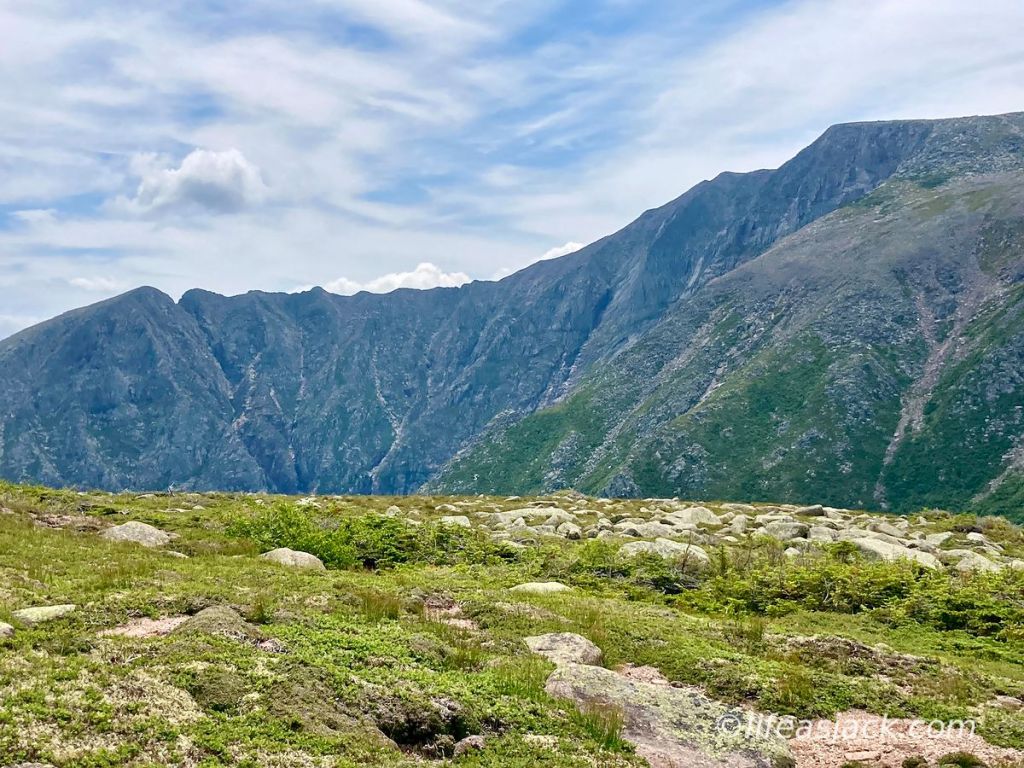
Today’s post is a difficult one to write. It is hard because it concerns a recent tragedy here in New England, that involves a pursuit that I enjoy the most- hiking in the mountains.
A man and his daughter, she only in her late twenties, recently succumbed to conditions hiking to the summit of Mount Katahdin in Maine. The story caught my eye on the national news. As with every fatal hiking incident, I was sad, seeing images of two smiling people and learning of the heartbreaking event. The two had traveled to Maine and planned to hike after conducting some business. I recognized that they were from the Catskills region, where I have been hiking this past winter and spring. Perhaps they had hiked often in the Catskills, or even the Adirondacks, which would give them some good hiking experience under their belts. Katahdin however, is a mountain unto itself.
Hiking in Maine
Having hiked all of the tallest peaks in New Hampshire and Vermont, I set my sights on Maine some years ago. Katahdin, Hamelin and neighboring South Brother were my final peaks on the list. I hiked the mountains with another experienced hike leader from a local hiking club. We hiked the peak in July, and chose the same trail and route to the summit as these hikers did. It was one of the hardest hikes I ever completed.
“Katahdin is a beautiful mountain.” one of my hiking friends once said. “There’s nothing in New England that compares to it.” She was quite right. It is also quite remote, in the far north of the state. If you have ever hiked in New England, you must understand hiking in Maine subjects you to some of the most rugged and challenging hiking in all of the northeast.
The mountain is located in Baxter State Park. The park has no electricity, no running water, and only composting toilets. You draw your water from mountain streams and purify it to drink. Anything you bring to the park, you must carry out. Cell service is virtually non-existent. If you are in the wilderness of Maine, your phone will be of little use. Help will be a long time coming, even if someone knows where to look, and that you need of assistance is already immediately known.
Katahdin in Summer
I arrived at Baxter with my friend after having made a reservation to stay at the park months in advance. There are limited sites and they fill up very quickly, booking out before summer starts. Because the mountain is also the finishing point for the Appalachian Trail, the campgrounds are busy in summer and early fall before cold weather and snow rolls in. Some thru-hikers meet relatives or friends here to head for home after finishing the AT. Others start here and hike southbound or “sobo”, back to the trails beginning in Georgia.
The Route to the Summit
I arrived in July, having hiked all summer, tuned up to go. I was in good shape, at my “fighting weight”. My companion was a bit older than myself, but an avid hiker and a resident of New Hampshire. He had hiked all of the 4000 footers in his home state, many in both summer and winter several times.

We camped at Abol Campground the evening before the hike, and began the next morning early. The trail takes you though woodland, but you eventually begin you ascent. Many years ago, the trail followed a path up a area that had been cleared by a landslide. ( frequently called “slides” in hiker terminology.) Later the path was relocated to a safer, but very challenging route. On this section of the Abol Trail, you climb a very steep path over large boulders. Sometimes you must use your hand to lift yourself up to scale this section. In the hot July sun, we scrambled up this trail sweating and moving carefully. It took a long time. When we reached the top of the slide, we were both drained. We had reached the Tablelands.
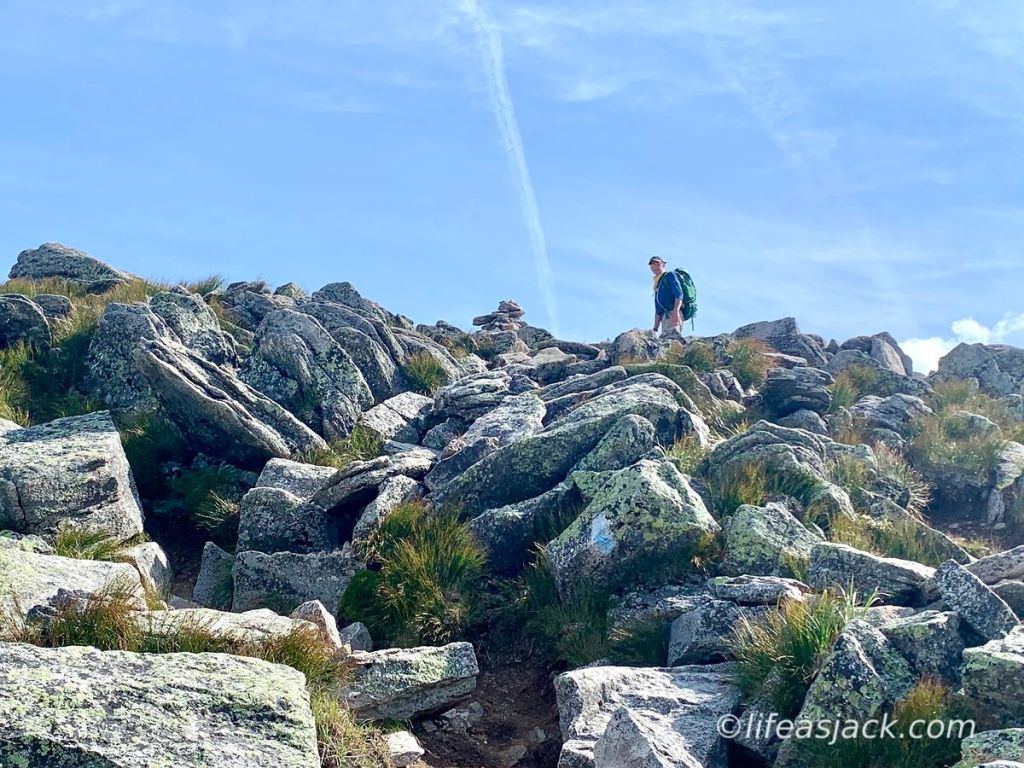
The Tablelands could best be described as a plateau of sorts. Its wide flat plain is crisscrossed with trails. At one point several trails converge at a crossroad, and each may lead you to a different campground in the park, or another mountain. The Tablelands are sort of like standing on the surface of the moon. Treeless, with some scrub and stony and dusty earth below your boots in July. An unforgiving environment. Far in the distance, we could see the summit of Katahdin. We began our march across to the mountain under the hot summer sun.

I don’t recall much about reaching the summit on the final leg, perhaps because it was the easiest part of the hike. We lingered to marvel at hikers coming up the Knife Edge, taking pictures. It was not something I would have enjoyed, and I hike mostly for pleasure. In calculating the risk, the juice wasn’t worth the squeeze navigating that arête.
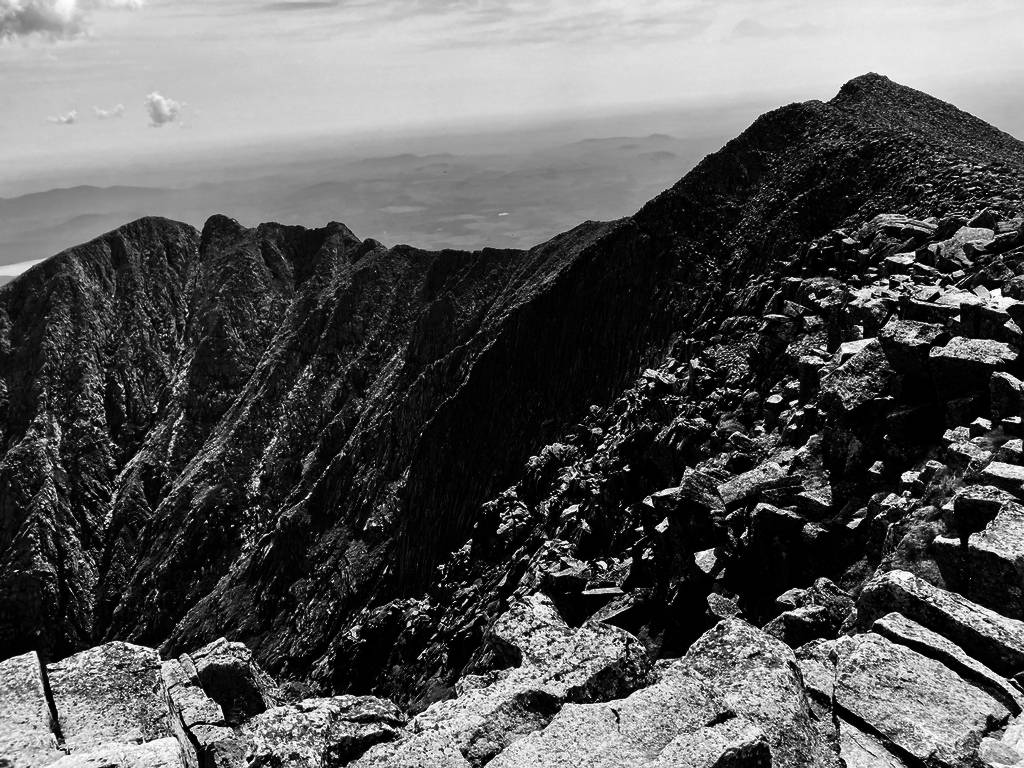
The Knife Edge, Mount Katahdin Maine, USA.
After descending from the mountain top, we traveled back across the Tablelands to the crossroad, and headed out to Hamlin, another mountain on our list. We preferred not to climb up here and hike the slide twice. Hiking Hamlin today would add miles to our hike, and elevation. After reaching Hamlin, we began our return. By now, we were low on water, and had to refill our bottles from a mountain spring on the wide open plain. Reaching the crossroads again, we encountered another hiker. She was sweating profusely. She had some bleeding scrapes on her knee, and seemed tired.
“Which way is Katahdin?” She asked. We told her.
“Which way did you come up?” My friend asked.
“I came up from the campground”
She marched on, and we left her behind, but I was concerned.
If you need to ask directions hiking in the woods, you are out of your element. Wilderness hiking require scrupulous attention to detail, knowing where you are at all times and considering all the “what ifs ” you can imagine. There are multiple campgrounds in Baxter. Did she know that? Would she know which path to follow on the way back?
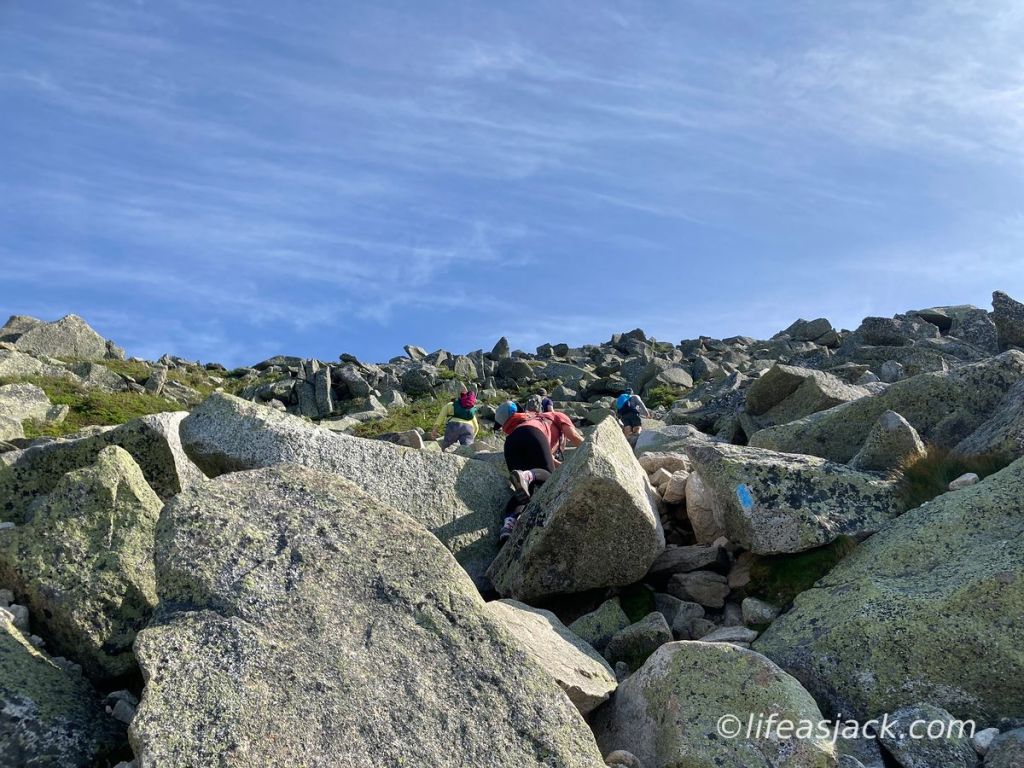
We began our descent of the slide after crossing the tablelands. The sun was past it’s zenith, but temperatures were at their highest. The hot rocks baked us as we climbed over them, slowing our progress to a crawl.
In the woods, a half mile or so from the campsite. My friend said,” I have to stop for a minute”
He rarely drank enough water while hiking. It was a concern I had when hiking with him. He sat on a rock and drank from his water bottle, saying nothing. After a few minutes he said, “a moment ago, I became disoriented. I didn’t know where we were, or what I was hiking.” He was suffering from heat exhaustion.
We soon reached camp, and he was feeling better. I was completely exhausted. We promised each other that if either of us was this depleted tomorrow, we would skip our third hike and go home. The mountains would be waiting for us another day.
I drank a liter of water to repair my muscles, ate heartily and downed two ibuprofen. Crawling into my tent I was soon asleep. It was getting dark now. It was easily a 13 hour day.
The next morning we were both recovered, and hiked our last required peak on a cooler, overcast day. We walked out to the trailhead in much improved condition.
The conditions on the day of the hike for the gentleman and his daughter on the mountain, according to the searching rangers was “terrible.” Strong winds up to 30 miles per hour, and precipitation: rain, freezing rain or snow.
When they were finally recovered, it was on the Tablelands. We cannot know what happened, but as can be noted in my own tale, It doesn’t take long for things to go wrong, even for the most seasoned hiker. Out on the windy, rain lashed exposed Tablelands at near freezing temperatures, should a person become disabled by hypothermia or a medical emergency, instead of heat exhaustion as my friend did, the result would be disastrous.
It’s difficult to get a day pass, or a campsite at Baxter. In many cases this can lead to choosing to hike in weather that one might have opted out of under normal circumstances. I’ve been self taught several life lessons while hiking that I will be relating on this blog, and fate will always be the hunter. I keep these thoughts present in my mind on every hike day:
“A sailor who does not respect the sea is soon drowned” – challenge mother nature at your own peril. She easily thwarts our technology on a daily basis.
“The mountains will still be there tomorrow.” Know when to turn back.
“No plan survives first contact with the enemy” Be prepared to pivot.
It’s just a hobby. It’s not worth your life.
 An Unmapped Route: A Hiker's Blog