

While hiking on New England’s trails, you often come across clues to the land’s past.

Stone wall in a New England wildlife management area. USA
Walking through the woodlands of New England will invariably lead you to a stone wall. In many cases you’d be hard pressed not to encounter one on a day hike. Deep in the woods, walls crisscross the land. Why would anyone build a wall in the forest?
Let’s roll back to the arrival of settlers in the 1700’s. The Rhode Island landscape had lovely smooth and rich soil in it’s forests, and was ideal for pasturing animals. Nary a rock was in sight. Native Americans often performed burns of the forest floor, keeping brambles and brush in check.
When settlers arrived, the New England farmers began clear cutting the land to farm. Without the trees, the cold temperatures penetrated the soil deeper and the “frost heave” caused the soil to move, bringing the stones deposited by glaciers in the ice age to the surface. The farmers would clear the field and the following winter, mother earth delivered more from below. The clear cutting had brought forth an annual crop of stones.
What to do with nature’s bounty? Build walls of course. But these were not walls to keep others out, but to pen the grazing sheep in.
The Napoleonic Wars had caused many of New England’s farmers to import many of Spain’s fabulous sheep that were know for producing fine Merino wool. The stone walls defined property lines and served as fencing. Before the land had been cleared, farmers had relied on timbers for pasture fence. Now the abundance of stone piled up to five feet high would replace them. Make no mistake- this was back breaking work that took years. Some was done by generations of subsistence farmers by it was also performed by hired labor, convicts and slaves.
By the mid 1800’s progress brought change.
The cotton mill, the industrial revolution and slave labor made cotton “king” and merino wool was a less valuable a crop. New England farmers moved west to New York and Ohio, many abandoning their farms for “greener pastures.” Within a decade brush and bramble had hidden many of the walls from view. The tribes that had cared for the land before the settlers arrived had lost access to their lands, their role as caretakers over. Trees began to return to the abandoned fields.
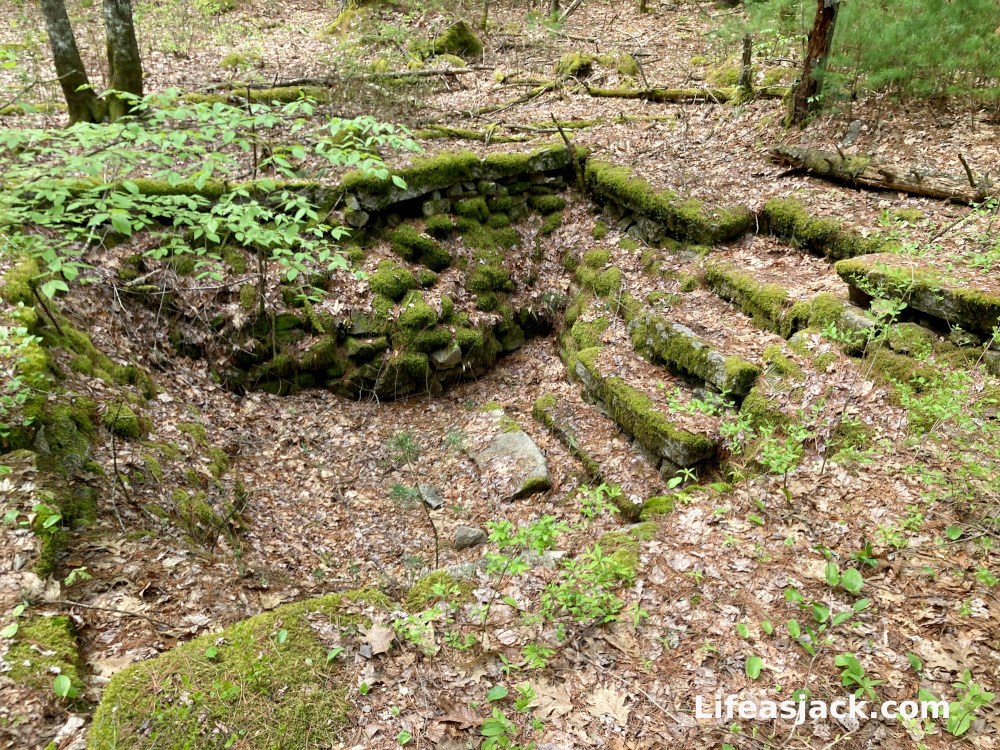
Cellar hole along a hiking trail in Rhode Island, USA
In New England there is still upwards of 100,000 miles of stone walls spread across the region. A bend in the trail may reveal a cellar hole, or animal pen, a boundary, stone bridge, even a family plot. The farmer’s bones lie beneath the soil in that cemetery.

The bones of the earth he brought forth still stand in small towns and in the now forested farm land that time has forgotten.
 An Unmapped Route: A Hiker's Blog