
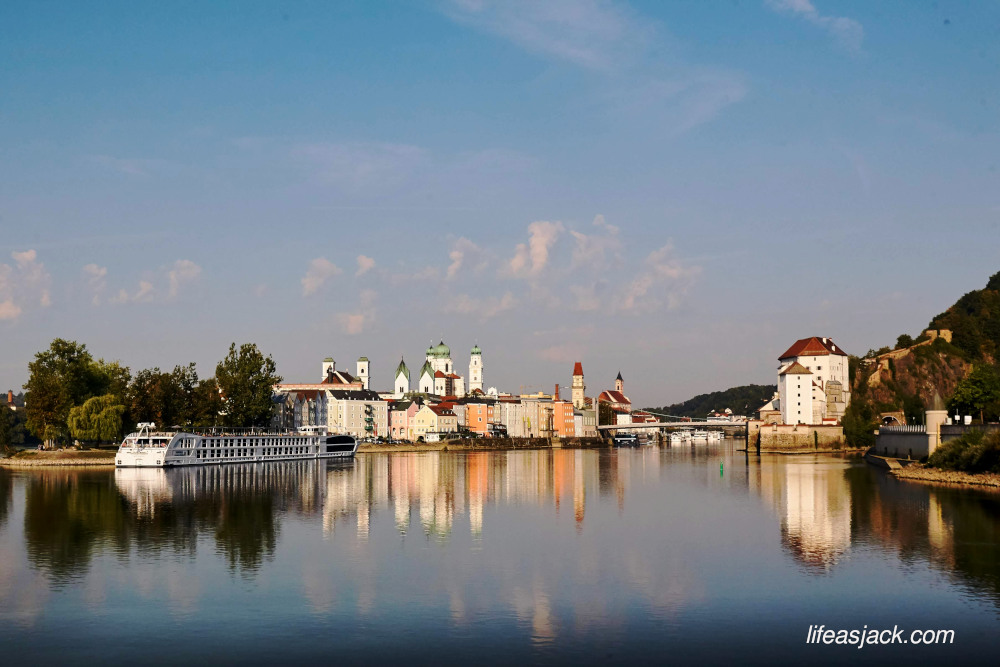
Also known as the Dreiflüssestadt, or the “City of Three Rivers.” The river Danube is joined by the Inn from the south and the Ilz from the north.
Jack arrived by riverboat, quite late to the party. The Celts had been here, but it was the Romans that really established the location in 50AD.
After the fall of the Empire, St. Boniface, the “Apostle of the Germans,” founded the Diocese of Passau in 739, and things really began to “heat up” as my New York friends might say.
Under these “Prince-Bishops” of the Holy Roman Empire, they established their own armies, minted coins and made Passau a city of power, wealth and spiritual importance.
The city suffered a few catastrophic blazes in the 1600’s reducing much of it to ash. The current “Old Town” would perhaps be better coined new town, but it would certainly still predate anything in the New World.
The Prince-Bishopric era would come to an end in the 1800’s when Napoleon’s antics in Europe caused many of the continent’s states to reorganize. Passau became part of the Kingdom of Bavaria and was transformed to a regional Bavarian city, losing it’s ecclesiastical identity.
By the time Jack had arrived, he found Passau, now a modern university city, boasting of having the advantage of a rich history, offering him a chance to wander through Old Town, with it’s wonderful baroque architecture and famed St. Stephen’s Cathedral. Jack was faced with the option to lace up his walking shoes and get a good stretch of the legs hiking to the Veste Oberhaus, an 800 year old fortification that is now home to the Oberhausmuseum as well.
Of course, you know what Jack chose…
 An Unmapped Route: A Hiker's Blog